What is the mechanism of spray drying granulation?
Spray drying granulation is a sophisticated particle engineering process that merges drying and granulation into one continuous step. This integration enables industries such as pharmaceuticals, foods, and chemicals to produce free-flowing, uniform granules with greater efficiency. By combining the two operations, it streamlines material processing while ensuring consistency and quality in the final product.
It is particularly significant for creating products with controlled particle size, morphology, and enhanced functional properties, addressing specific industry demands for quality and efficiency. This advanced technique allows for the precise manipulation of material characteristics, ensuring consistent product outcomes.
What is the spray dry granulation technique?
The spray granulation process is a singular and integrated method that converts liquid feed into solid, granulated particles by precisely controlling atomization, drying, and subsequent particle growth. This technique is highly valued for its ability to produce materials with specific size, density, and flow characteristics. It successfully streamlines production by combining what would typically be separate drying and granulation steps – a key distinction when considering the benefits of spray drying granulation vs. spray drying.
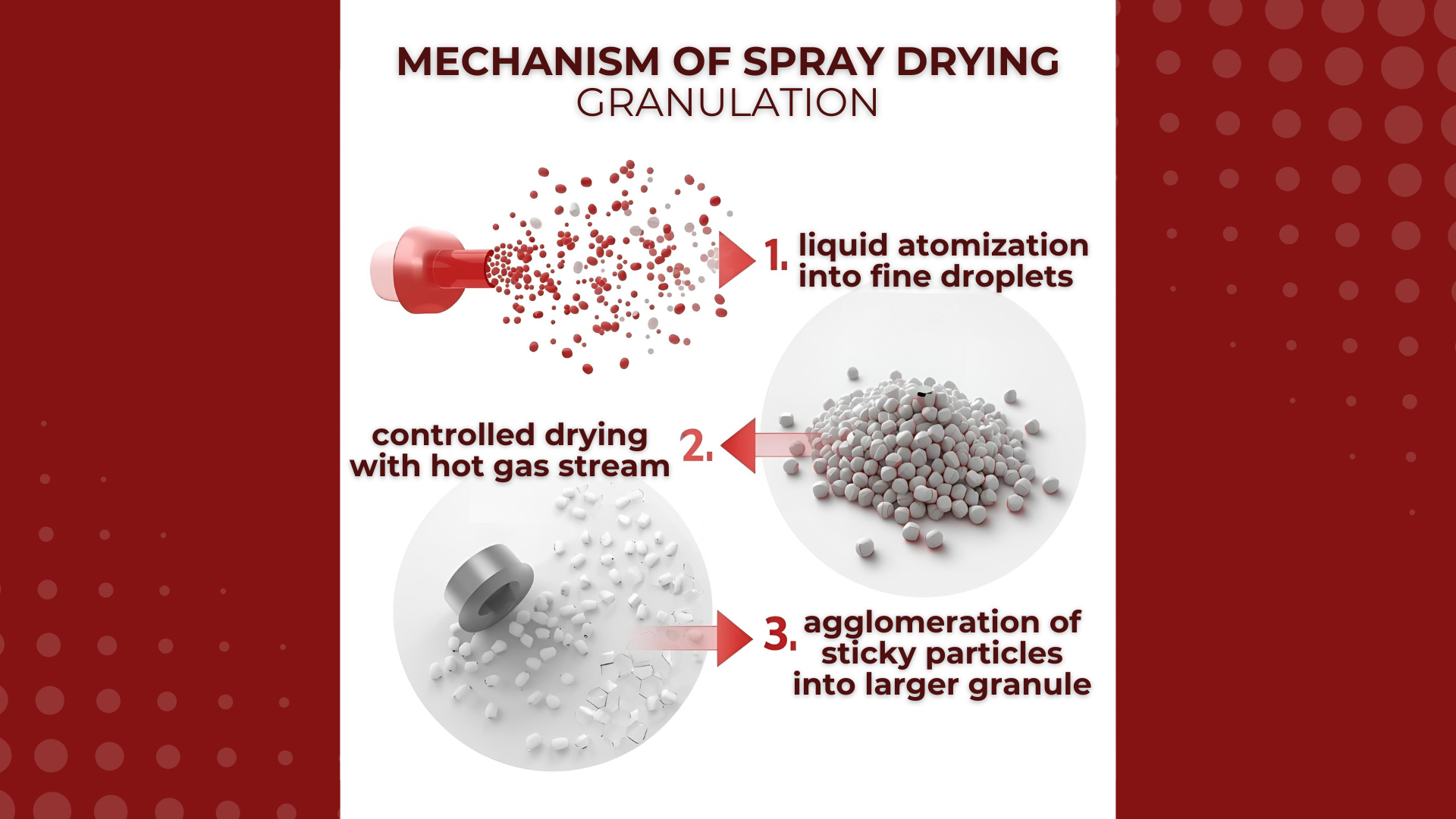
The core steps involved are:
- Atomization and Droplet Formation: Liquid feeds (solutions, slurries, or suspensions) are atomized into fine droplets, typically tens to hundreds of micrometers – using pressure nozzles, rotary disks, or two-fluid nozzles. This maximizes surface area for rapid evaporation; for example, atomizing 1 liter of liquid into 250 µm droplets creates about 24,000 m² of evaporation surface.
- Controlled Drying and Solidification: Droplets exposed to hot gas lose moisture quickly, forming a crust or skin as the solids concentrate. This ensures product stability and functionality.
- Agglomeration: Semi-dried, sticky particles collide and adhere, forming larger granules. Recycling fine particles or adding binders can strengthen agglomerates and improve the consistency of the final product.
This approach offers precise control over powder properties, making it a powerful method in industries requiring uniform, free-flowing granulated products.
What is the principle of spray granulation?
Spray granulation operates by spraying a liquid feed into a hot drying chamber, where the resulting droplets partially dry and then collide and coalesce to form granules. This continuous process transforms a liquid or slurry into solid, often spherical, particles. As these may contain dissolved solids or suspended particles along with binders, they are next atomized into fine droplets.
These droplets enter a hot drying gas, typically air, where rapid moisture evaporation begins. As the droplets partially dry, they become semi-solid and sticky. In this state, they collide with other droplets or existing particles, adhering together to form larger granules. This process continues until the desired granule size and moisture content are achieved.
Several factors critically influence the resulting granule size, including the initial droplet size, the concentration of binder in the feed, and the drying temperature within the chamber. For example, a higher binder concentration can lead to stronger, larger granules. The operating efficiency of a spray granulation machine can also vary meaningfully based on these parameters.
What is the difference between spray drying and fluid bed granulation?
Spray drying is a process that transforms a liquid feed (solution or suspension) directly into dry solid particles or powder. This occurs through atomization of the liquid into fine droplets, followed by rapid solvent evaporation, typically using hot air. This fast drying often leads to hollow particles due to solids precipitating at the droplet surface. Pulse atomization spray drying enhances this process by using pulsating hot gas and intense turbulence for high drying rates, energy efficiency, and superior powders with hollow structures.
In contrast, fluid bed granulation is a particle engineering process that starts with existing solid particles. The fluid bed granulator working principle involves suspending these particles in a fluidized state using an upward gas flow as a liquid (often a binder solution) is sprayed onto them. As the liquid dries, it causes particles to grow or acquire new properties through:
- Agglomeration: Small particles join to form larger structures.
- Granulation (Layering): Liquid coats the particle surfaces, forming uniform layers.
- Coating: A thin layer is applied to modify existing core particles. This method results in coarser, easy-to-handle products. RF-assisted fluidized bed drying is an example of a technique that enhances drying rates and energy efficiency in this process.
The fundamental difference lies in the starting material and the mechanism: spray drying converts a liquid into powder via evaporation, while fluid bed granulation builds up or modifies existing solid particles by applying a liquid and drying them in a fluidized bed.
Conclusion
Pulse Drying Systems offers expert consultation for advanced drying and granulation needs. Their custom spray granulation solutions deliver unparalleled efficiency, achieving 45% to 67% levels as compared to conventional dryers at 28.5% to 40%. by maintaining lower-than-usual outlet temperatures (70–105°C) through intense mixing and rapid, uniform drying, they ensure superior product quality featuring low protein denaturation and improved color characteristics.
Contact Pulse Drying Systems today for a custom solution tailored to your specific application.
Frequently Asked Questions
Spray drying granulation can utilize various materials, including:
- Soluble polymers like PVA (polyvinyl alcohol)
- Sugars such as lactose or sucrose
- Active pharmaceutical ingredients (APIs)
- Food additives and flavorings These materials are selected based on their solubility and the desired properties of the final granules.
The spray drying granulation process offers several benefits, including:
- Uniform particle size and distribution
- Enhanced solubility and bioavailability
- Reduced processing time compared to traditional granulation
- Ability to encapsulate sensitive ingredients
- These advantages make it ideal for pharmaceuticals and food products.
Spray drying granulation can enhance product stability through:
- Rapid drying, which minimizes degradation
- Homogeneous mixing of active ingredients with excipients
- Formation of protective layers around sensitive compounds This stability is crucial for maintaining efficacy and shelf life.
Spray drying granulation is widely applied in several industries, including:
- Pharmaceuticals for drug formulation
- Food and beverage for flavoring and nutrition
- Chemical manufacturing for producing fine powders
- Cosmetics for formulating powders and emulsions These industries benefit from the technique’s efficiency and versatility.
Challenges in spray drying granulation include:
- Controlling particle size and morphology
- Ensuring uniform drying without clumping
- Managing heat-sensitive materials that may degrade
- Scaling up the process for industrial production Addressing these issues is crucial for successful implementation.
Optimization strategies for spray drying granulation may involve:
- Adjusting the feed rate and nozzle design
- Fine-tuning the inlet and outlet temperatures
- Selecting appropriate drying agents and solvents
- Conducting trials to identify the best formulation These adjustments can enhance efficiency and product quality.
Temperature significantly impacts the spray drying granulation process by:
- Affecting the evaporation rate of the solvent
- Influencing the formation of granule morphology
- Determining the final moisture content of the product Optimal temperature settings are essential for achieving desired results.
Yes, spray drying granulation can be tailored for sensitive compounds by:
- Using lower temperatures during the drying process
- Selecting protective excipients that shield the active ingredients
- Implementing a controlled environment to minimize exposure to heat. This adaptability allows for effective formulation of delicate materials.