What is the use of a spray dryer?
Spray drying is a versatile and widely employed drying technology that converts liquid feedstocks such as solutions, slurries, or pastes into dry powders. This process involves atomizing the liquid material into fine droplets, which are then introduced into a hot drying medium, typically air. As these droplets rapidly come into contact with the hot gas, the moisture within them quickly evaporates, leading to the formation of uniform, fine powder particles.
This method is fundamental to numerous industries for its capacity to produce powders with specific desired characteristics, improving product stability and functionality.
What is spray drying used for?
Spray drying is used for converting various liquid raw materials, solutions, or emulsions into a dry particulate form. Its primary goals are to improve shelf life, reduce volume and weight for more efficient transport and storage, and enhance ease of use of the final product. Spray drying also allows precise control of powder properties such as bulk density, particle size distribution, and moisture content, which are essential for flowability, solubility, and long-term stability.
Spray drying is an efficient thermal process that facilitates the creation of fine powders from a wide range of feed types, from highly concentrated slurries to low-viscosity solutions. The adaptability of spray drying technology makes it indispensable in sectors that demand precise control over the properties of the resulting powder.It ensures consistent performance even when processing challenging feed materials or meeting stringent regulatory and quality assurance standards demanded by specialized industries.
How is spray drying used for food processing?
Spray drying is extensively used in food processing to create stable, high-quality food powders, with a strong emphasis on energy efficiency and the preservation of crucial nutritional and functional benefits. This drying technology is particularly advantageous for food products that are sensitive to heat, light, or oxygen. Foods that can be spray-dried include a diverse range of items:
- Dairy products: Commonly, skim milk, whole milk, and whey powder are produced, with a focus on controlling crystallization and maintaining properties like protein stability.
- Fruit juices and flavors: Spray drying enables the encapsulation of flavors, preserving their volatile compounds, extending shelf life, and ensuring consistent product quality. This method also enables cost-effective scaling from pilot trials to full industrial production without compromising formulation integrity.
- Starches and other carbohydrates: These are frequently processed into powders for various applications, with ongoing research to understand their amorphous and crystalline transitions during drying.
Advanced methods, such as pulse atomization drying (PAD), further enhance these benefits in food processing. For instance, the application of PAD to egg white, a heat-sensitive protein composition, demonstrates superior physical characteristics and properties compared to traditional spray drying. Gel hardness – a key quality indicator – was significantly improved. Whereas traditional spray-dried egg whites had a mean gel hardness of 486.5 grams, PAD powders achieved 957.6 grams, indicating markedly better gelling properties. This illustrates PCD’s ability to minimize protein denaturation and enhance functional attributes.
What industries use spray drying
In pharmaceuticals, spray drying is vital for producing dried active ingredients and excipients, particularly for heat-sensitive proteins and compounds where stability is critical. It is widely used to create amorphous solid dispersions (ASDs) that improve drug solubility and bioavailability, and for inhalable powders used in pulmonary drug delivery.
In vaccine production, spray drying ensures antigen potency and long shelf life by maintaining moisture levels below 8%, which is paramount to maintaining biological activity and stability. It is also employed for high-value products like dried viral vaccines, where preserving viability and antigenic potency with a moisture content of less than 8% is critical for long shelf life. The notably short residence time of materials in the drying chamber, combined with controlled temperatures in advanced spray dryers, helps minimize degradation of these delicate materials.
Beyond food and pharmaceuticals, spray drying is utilized in various other industrial sectors, including:
- Chemicals: For producing pigments, catalysts, and ceramics.
- Food Products and Nutraceuticals.
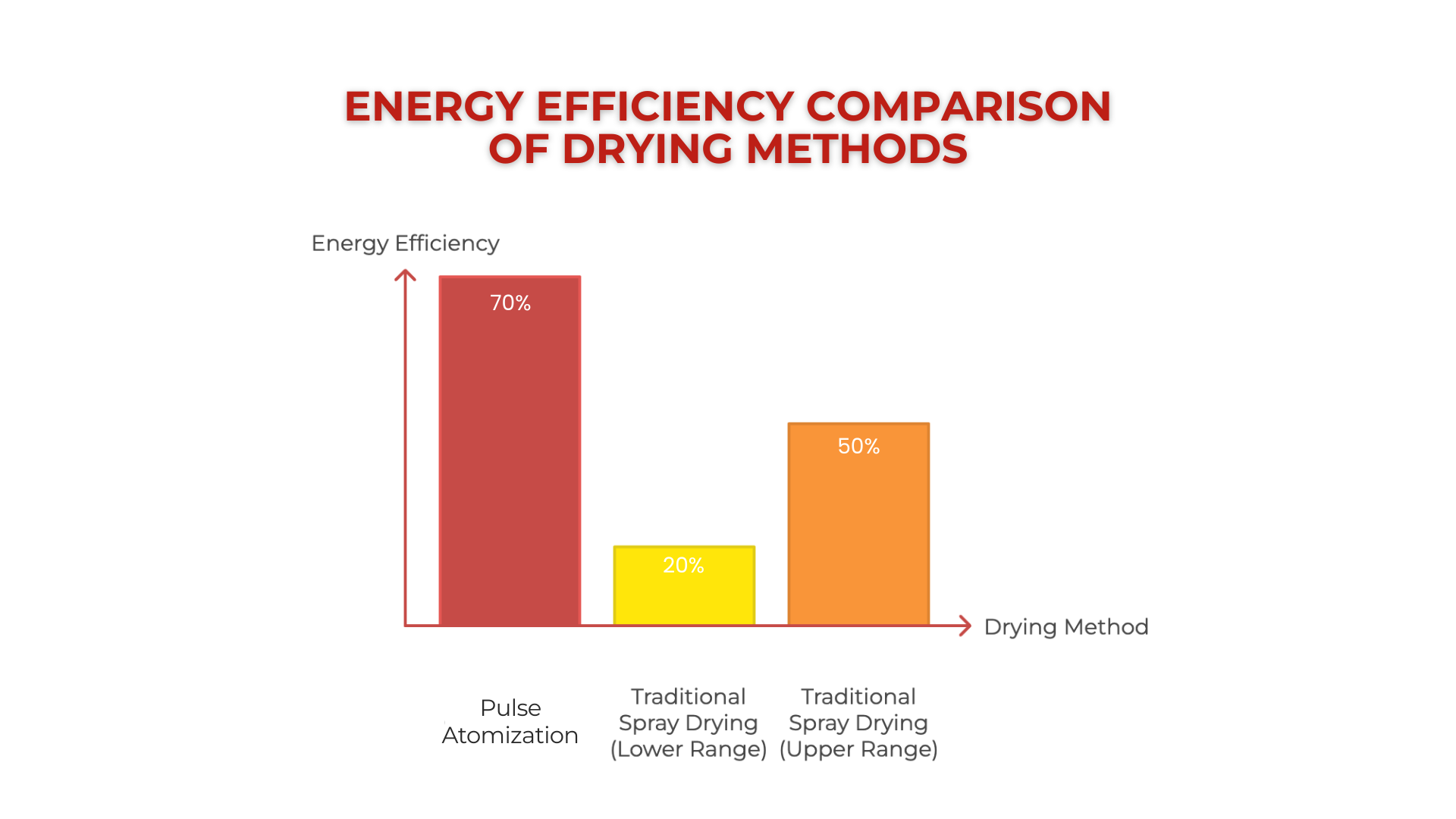
Pulse atomization drying stands out as an advanced drying technology in these fields due to its impressive energy efficiency. Studies show Pulse Atomization Drying (PAD) can reach up to 70% efficiency in moisture reduction, compared to traditional spray dryers that usually operate between 20% and 50% efficiency, depending on design and operating conditions. Coupled with PCD’s capability to maintain product quality for sensitive materials, makes it a preferred solution for demanding applications.
Conclusion
The versatility and effectiveness of spray drying position it as an indispensable drying technology across diverse industries. From elevating product quality and energy efficiency in food processing to safeguarding the integrity of heat-sensitive proteins in pharmaceuticals, its applications are extensive and impactful. Innovations like pulse atomization drying continue to advance the capabilities of this method, delivering superior results for even the most challenging materials.
To learn more about how Pulse Drying Systems can provide innovative spray drying solutions tailored to your specific needs, or to explore how customized drying technology can meet your production requirements, we invite you to contact us via www.pulsedry.com for a consultation.
Frequently Asked Questions
Spray drying is widely used in various industries, including:
- Food and beverage (for powdered products)
- Pharmaceuticals (for drying active ingredients)
- Chemicals (for producing fine powders)
- Ceramics (for drying wet-milled products)
The benefits of spray drying include:
- Rapid moisture removal, preserving product quality
- Ability to create uniform particle sizes
- Enhanced shelf life for powdered products
- Versatility in processing a wide range of materials These advantages make spray drying an efficient choice for many manufacturers.
Spray drying can significantly enhance product quality by:
- Reducing moisture content, which prevents spoilage
- Maintaining flavor and nutritional value in food products
- Allowing for controlled particle size and density. This process ensures that the end product meets specific quality standards.
A typical spray dryer consists of several key components:
- Feed pump: Delivers the liquid feed to the Atomizer
- Atomizer: Breaks the liquid into fine droplets
- Drying chamber: Where the drying process occurs
- Collection system: Captures the dried powder
- Dust Control; captures “fines” to prevent emissions problems
- Powder Transportation and Packaging
- Understanding these components can help in selecting the right spray dryer for specific applications.
The spray drying process involves:
- Pumping the feedstock to the Atomizer
- Atomizing the feed into fine droplets using high pressure, centrifugal force, or Pulse Atomization
- Exposing the droplets to hot air in a drying chamber, causing rapid evaporation of moisture
- Collecting the dried powder in a cyclone and/or baghouse.
- Collecting the fines, if any, in a baghouse or scrubber.
Several factors can influence spray drying efficiency:
- Inlet air temperature: Higher temperatures improve thermal efficiency, especially when linked with low outlet temperatures as is possible Pulse Atomizing dryers.
- Feed concentration: A higher solids concentration increases throughput and decreases costs
- Droplet size: Smaller droplets dry faster but may require precise control
- Airflow rate: Impacts how quickly moisture is removed
- Optimizing these factors can lead to better product outcomes.
Yes, spray drying can be used for heat-sensitive materials by:
- Adjusting the drying parameters (e.g., lower inlet and outlet temperatures)
- Using specialized equipment (e.g., multi-stage dryers)
- Employing encapsulation techniques to protect sensitive components These methods help to preserve the integrity of heat-sensitive products during drying.
Safety considerations include:
- Explosive Safety Systems designed to handle dust explosions
- Proper ventilation to handle airborne particles
- Regular maintenance to remove dust accumulations
- Use of personal protective equipment (PPE) for operators
- Compliance with industry safety standards
- Taking these precautions can help ensure a safe working environment during spray drying operations.